"Redis in Enterprise AI: Rate Limiting, Token Security, and Session Management"
Redis doesn't get conference-talk glory, but without it, real-time multi-user AI systems fall apart. Single-use HMAC tokens, sliding-window rate limiting, session registry — here's the full implementation with production configuration and graceful degradation patterns.
"Cache and Memory Architecture: How Enterprise AI Gets Faster and Smarter Over Time"
Cache answers "have I computed this before?" Memory answers "what do I know that helps me now?" They're different systems with different lifecycles — and combining them is what makes an enterprise AI platform dramatically more capable and economical than a stateless chatbot.
"The Agent Chat Runtime: From WebSocket to Streamed Response"
What actually happens between the moment a user sends a message in AI Studio and the moment the first token appears on screen? Eight steps, HMAC token security, LangGraph graph execution, Redis rate limiting, memory injection, and real-time streaming — all in under 200ms to first token.
"The Agent Builder Runtime: The AI That Designs AI"
The Agent Builder Studio is a meta-agent — an AI whose job is to design other AI agents. A 7-stage methodology, a multi-node LangGraph topology, and an evaluator that checks every artifact before it's written to disk. Here's how it works end to end.
"The Agent Factory: How Declarative Primitives Become Running Agents"
Building a new AI agent shouldn't require an engineer and a two-week sprint. In Getraind, an agent is a markdown file — topology, prompts, and metadata — that the Agent Factory compiles into a running LangGraph graph on demand. Zero code, hot reload, no redeployment.
"Designing Enterprise AI: From Business Problem to Agent Architecture"
Before you buy a GPU or write a line of agent code, there are four questions that determine whether your enterprise AI succeeds or fails. Most teams skip them. Here's how I think through the design process — from identifying the right problems to mapping them to agent topologies.
"GPU Hardware and Model Selection for Enterprise AI: The Math Nobody Shows You"
How many GPUs do you actually need? The vendor answer is "buy more." The honest answer requires math — model memory requirements, concurrent user throughput, latency SLAs, and a tiered model strategy that can cut your GPU footprint by 60–70% compared to the naive approach.
"The LLM Gateway: How to Route AI Requests Intelligently and Cut Costs by 60–80%"
Every enterprise AI request doesn't need the same model. A routing decision costs microseconds on a 7B model. A deep reasoning chain needs your most capable. The LLM Gateway is the component that enforces this — and the difference in monthly cost is not 10%. It's 60–80%.
"The Enterprise AI Reckoning: Why Cloud AI Is a Trap and What to Build Instead"
Every enterprise is racing toward AI. Most are doing it wrong — paying cloud providers a fortune, leaking sensitive data, and building nothing they own. Here's what I've learned building a complete enterprise AI platform from scratch, and why the real work has nothing to do with ChatGPT.

"Deploying OpenShift with Ansible: A Production-Grade Automation Playbook"
Deploying OpenShift on bare-metal servers is a multi-step orchestration problem — authentication, cluster creation, static networking, ISO booting via Redfish, host discovery, and post-install operators. Here's a complete walkthrough of an Ansible automation framework that handles all of it, including idempotent state management and Day-2 operations.
"Building Enterprise AI Infrastructure: What an Architect Actually Goes Through"
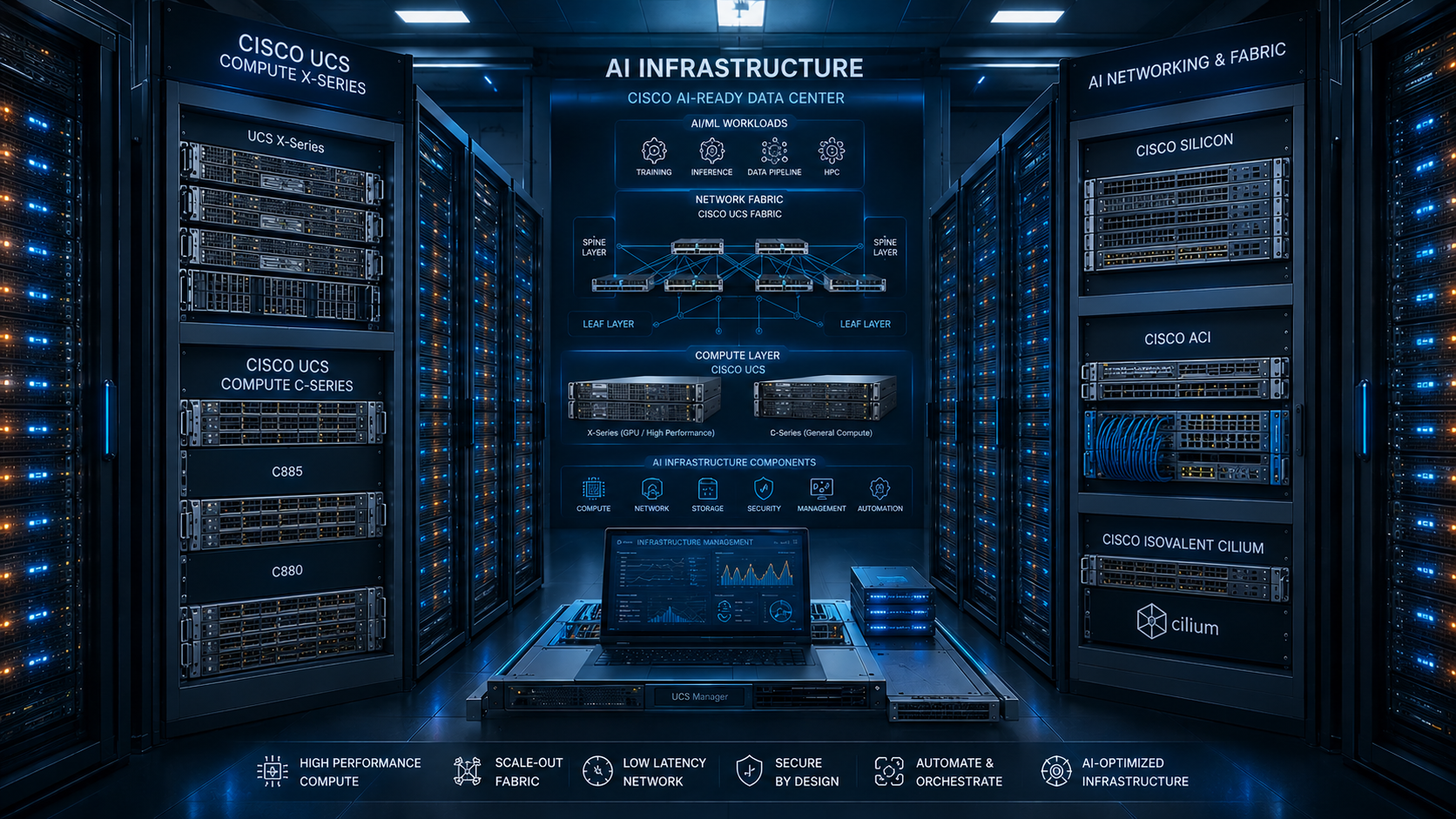
Enterprise AI isn't just about buying H100s. It's a multi-layer architecture problem involving resiliency, redundancy, load balancing, GPU scheduling, and months of decisions that nobody documents. Here's the full stack from the perspective of an enterprise AI architect working with Cisco UCS and OpenShift.